Long-awaited M Street Southeast underpass opens to traffic
Published 5:04 pm Wednesday, July 24, 2013
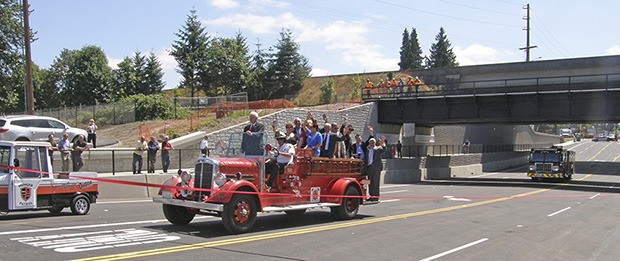
After plenty of speechmaking offered up by dignitaries under clear skies at the intersection of 4th Street Southeast and M Street Southeast Monday afternoon, Auburn City Councilmembers and other leaders piled into a Pirsch antique fire engine.
Moving forward, the engine pushed through a red ribbon, and Auburn’s M Street Southeast underpass was open.
It all happened before a perspiring but happy crowd of more than 100, and under the eyes of the workers who built it, a clutch of them watching from the top of the underpass.
A snappy ending to a project whose realization was anything but.
“So long in coming,” Auburn Mayor Pete Lewis said about the Freight Action Strategy for Seattle-Tacoma (FAST) Corridor project, which dates to the administration of his predecessor, Chuck Booth, in the mid 1990s. The FAST projects were designed to remove traffic chokepoints and improve freight mobility.
The project, on which actual construction began in February 2012, separates M Street Southeast from the at-grade Burlington Northern Santa Fe (BNSF) Railway’s Stampede Pass rail crossing. Without this separation, there would soon have been interminable backups, while traffic waited for anticipated mile long trains to make their way along the tracks.
“This makes a difference for our city, this makes a difference for the Puget Sound Region … Burlington Northern Santa Fe having the ability to open Stampede Pass when it chooses,” Lewis said, going on to heap praise on every agency and board that played a role in making it happen and laurels on a City Council he said “that never, ever quit.”
Funding for the $22.3 million project came from multiple sources, among them the Ports of Seattle and Tacoma, BNSF Railway, the Washington State Transportation Improvement Board (TIB), the Washington State Freight Mobility and Strategic Investment Board (FMSIB), the Washington State Public Works Trust Fund Board, federal grants, the King County Department of Natural Resources and Parks-Wastewater Treatment Division and local funds.
Rich Wagner, chairman of Auburn’s Public Works Committee, recalled one especially dark moment when the project, halfway through the planning stages but without prospects for getting the necessary funding, stood on the brink of oblivion.
“About halfway through this, the Public Works Committee actually considered terminating it,” Wagner recalled. “We were in such a bind for funding, and having people like the ports and others step forward, and the (state Transportation Improvement Board), they really pushed it over the top and made it happen. … There are hundreds involved in making this happen, and they all deserve credit.”
Auburn School District Superintendent Kip Herren explained why the project matters so much to the district’s 15,000 students and to its buses, which put in almost 1.2 million miles every year.
Before Monday, school buses had to line up all the way through the lights north on M Street Northeast.
“The wheels on the bus can go ’round, and we can make more efficient stops. We won’t spend as much time at the lights, so we’ll save fuel. That means the kids will be better behaved than when they’re waiting on the bus. It means there’ll be better stops along the way for all of our students and families,” Herren said.
Dan Gatchett, chair of the state Freight Mobility-Strategic Investment Board, which contributed $6 million to the project, noted that some 600 trucks cross M Street every day, and the underpass project will eliminate daily closures that can add 15 minutes to a truck’s trip. He said FMSIB’s mission is to eliminate freight chokepoints and mitigate freight impacts to the communities.
“At $60 an hour for the trucking industry, it doesn’t take long for FMSIB’s investment to pay off,” Gatchett declared.
The M Street underpass is the last of the FAST Corridor projects, among which is the Third Street Southwest Grade Separation Project
“FAST Corridor was an idea that we could begin to put together a number of transportation projects from the Port of Seattle and across the Cascades,” said Port of Seattle Commissioner Bill Bryant. “Today we are celebrating not just opening the M Street underpass but the completion of that corridor, which is going to allow us to keep jobs here in Washington State.”