
Auburn High School students excel in robotics club
Published 10:36 am Thursday, February 25, 2010
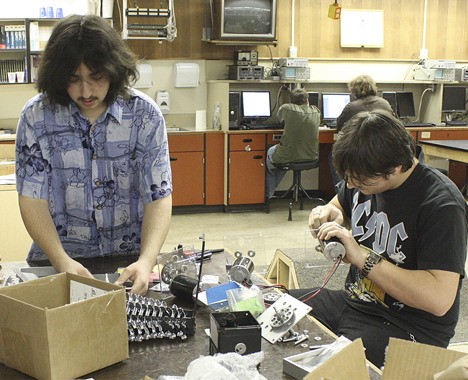
Jan Erie knows full well the impact of the FIRST Robotics program.
When the Auburn High School English instructor’s son, Mike Erie, was attending Tacoma’s Bellarmine Prep High School, he participated in the nationwide program – which seeks to foster careers in the science and technology industries through participation in robotics competition.
Erie said the impact of her son’s participation in FIRST, where he helped build a robot to compete with other robots in a regional competition, was so great that it helped lay the groundwork to get into the Illinois Institute of Technology on a full tuition scholarship.
“I link that to his participation in FIRST,” Jan Erie said.
So when she found out that vocational instructor Chris Zawislak was interested in starting up a robotics club at Auburn High School, she jumped at the chance to lend a hand.
“I told him that I would fund raise and do his paperwork and make it possible to happen,” she said.
On Jan. 9, members of the Auburn TREAD (Technology Robotics Engineering and Design) Robotics Club gathered with other clubs in the area at Mountlake High School for the kickoff of this year’s competition.
Originating in 1989, FIRST – which stands for For Inspiration and Recognition of Science and Technology – hosts an annual series of robotic competitions where clubs assemble robots and program them to compete in a game with other member clubs.
This year’s competition, called Breakaway, is similar to soccer. The game features teams of three robots each, attempting to maneuver their way through a playing field split into three zones by two speed bumps, each about 13 1/2-inches high. The robots will attempt to score points by shooting a soccer ball into 48-inch-tall-by-24-inch-wide goals. Positioned in the middle of each bump is a 7-foot tall tower, constructed of pipe with a platform 21-inches off the floor of the field. The towers also feature a tunnel, that robots can scoot under to move towards their goals. Robots can also traverse the bump to move into the attacking zones. At the end of the match, robots can score extra points by hoisting themselves onto the towers or latching onto robots from their team already suspended on the towers and hanging off the field floor.
Although the competition is the ultimate goal and reward for the competitors, the real work started immediately after the kickoff. For Auburn, it started with a crate of parts.
“You get a kit of parts supplied to you,” Jan Erie said. “But you’re not limited to that kit of parts. You can add another $3,500 worth of parts and materials on to there.”
Erie said in addition to the parts kit, the participants also receive a 35-page set of rules.
“They are very detailed, very specific, lots of things like you can’t put nuclear fuel on this,” she said. “And then they have six weeks to put it together.”
For Anthony Garoutte, the club’s president, just receiving the parts was a victory.
Last season the Auburn senior participated with the Auburn Mountainview robotics club.
“I really just wanted to do something down here, have our own team to show our school spirit,” Garoutte said. “I know a lot of kids didn’t get the opportunity. So I had a lot of friends down here who are really smart and might like the opportunity to do something that might help get them into college.”
Building skills
According to Jan Erie, the secret of the program is the way it melds the thrill and fun of competition with real world skills that students can translate into the business world.
“What is wonderful about this program is that it involves so many different skill sets,” she said. “They call it the sport for the mind, which is one of the coined phrases from the national organization. And I really believe that.”
In addition to the actual construction of the robot, Erie said the clubs had to know how to raise money, market themselves and promote the club.
“It’s very complex and you have six weeks to do it,” she said. “And it’s a drop-dead deadline because Fedex comes to pick up these robots, they do it for free. And when they come, you have to be ready for the competition. And that’s a lot like a business deal. You have a concept, you figure out how you have to do that, you build it and you ship it. To me, that’s a real-world problem.
“And on the business side, you have to fund raise,” she continued. “It’s an expensive sport. To start you need $6,500. That’s to get you into one competition and your set of parts. If you want to compete in other competitions, it’s $4,000, plus the housing and getting your team there and back. It’s pricey.”
“We’re not all just engineers and programmers,” Garoutte added. “We do fundraising, and we have public relations people. We work with Art Club to do buttons and shirts. We’re learning interpersonal skills, how to be outgoing. And we’re learning how to work with people in a work environment. We have deadlines and other things that people in business have to deal with.”
Currently, the Auburn Robotics Club is preparing for the Microsoft Seattle Regionals at KeyArena on March 26-27.
For more information on the Auburn Robotics Club, visit www.auburnrobotics.org.
For more information on FIRST, visit www.usafirst.org.