Creators ‘Walk the Talk’ with show of public art
Published 11:07 am Thursday, October 1, 2009
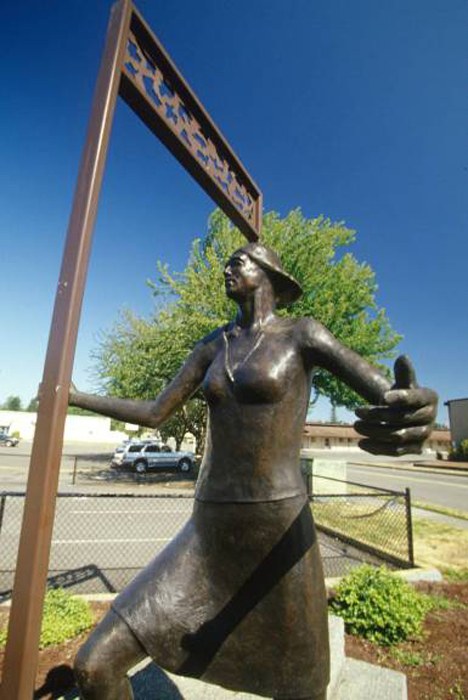
Auburn’s public artists steep their works in the city’s history with its rich tableau of the White and Green rivers, the fish that swam in their waters, the Native Americans who depended on them for sustenance, the farmers who came to till the soil and now lie under it.
Artist Gerard Tsutakawa wanted his circular sculpture “Sun Circle” to embody the pulsating energy of Game Farm Park. Susan Zoccola scoured her old physics textbooks, then studied the elegant swing of Tiger Woods to create “Swing and Flight” at Auburn Municipal Golf Course.
The Auburn Arts Commission celebrated its 25th birthday last Thursday by bringing the public face to face with these and seven other nationally and internationally recognized artists responsible for the city’s public art. Called “Walk the Talk: Public Art in Auburn,” the event at Auburn Avenue Theater featured artists discussing their ideas, putting their art in context and sharing stories.
Public art matters, said Nancy Colson, chair of the Auburn Arts Commission, adding that it can make an ordinary place extraordinary.
“Art makes space more accessible to people,” said Colson. “People feel welcomed by spaces that are enriched by art.”
In time, the works may become such old friends that folks may pass by and not see them. But each piece had its maker who grappled with the puzzles it posed and solved them.
Phillip Levine described how place influenced the design and concept of “Threshold,” the sculpture of a woman walking upstairs that greets visitors entering Les Gove Park from 12th Street. Thresholds and passages, he said, have always gripped his imagination.
“To have the sculpture at the entrance of the park struck a very strong chord in me in terms of what do you gain by entering the park, what do you gain by going through a passage,” said Levine. “… Passages and thresholds have a lot more meanings than you could illustrate in any work of art, and I found out it was very much a wonderful way to start, knowing that I was dealing with the entrance to a community.”
Michele Van Slyke, who in 1993 created “Every Year the Salmon Return” at Roegner Park, described what compels her to make public art and keep at it. She sees a big difference between art she creates for galleries and public art. When she creates art for galleries, Van Slyke said, of course she hopes that somebody will connect with it. But in those works she satisfies herself without consideration for whether the work is politically correct or long lasting.
“But with public art the satisfaction for me is to see people react to my work,” Van Slyke said. “Maybe it’s not as way-out, but for many people it’s a medicine, and their reaction to it is so important, even if they react negatively.”
Meg Pettibone, the artist behind the granite work called “Steelhead” at Isaac Evans Park in 1989, said her first challenge was to find the message and convey it within the bounds of the budget. She also was concerned about having her piece survive, given the vandalism rampant at the park at that time.
She said she went through about 30,000 negatives to come up with the twisting steelhead now cut into the black stone.
“The subject was easy to come up with,” Pettibone said. “Steelhead used to run strong in the Green River, and I felt drawn to their cause. The message was about the lost habitat, and the steelhead were becoming endangered.”
Other artists present and their works were as follows: Garth Edwards, B-Street Plaza, 1995; Ingrid Lahti, Les Gove community campus entry sign, 2005; Darel Grothaus, Number 24 Evergreen Washelli at Mountainview Cemetery, 2005; and Virginia Paquette, Community Center Integrated Artwork, in progress.
Public art programs began in the United States in 1959, and today 300 cities, including Auburn, have public art programs.