
At a time of heightened tensions about the rising tide of youth related crimes in Auburn in 2024, local leaders stepped into the community to meet with residents and sound them out on public safety.
Those leaders, including Mayor Nancy Backus and Auburn School District Superintendent Alan Spicciati, used what they heard, though some of the feedback surprised them. During a meeting at Chinook Elementary School, they heard local residents complain not only about shots heard in the night, but also about drivers zipping through their neighborhood at all hours of the day.
Keen to keep the chat going, Backus recently launched round two of Community Conversations at schools and other locales throughout the city.
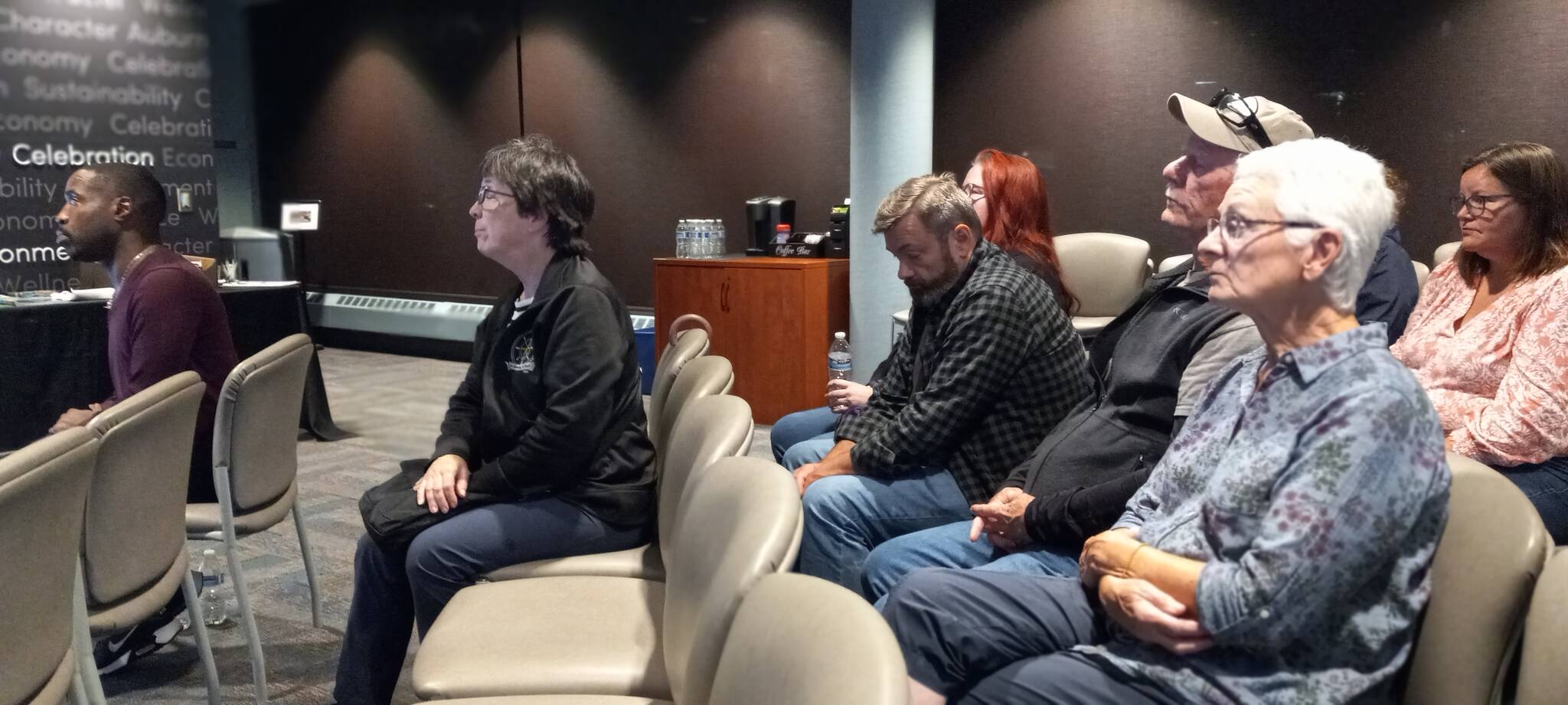
On the rainy Tuesday night of Sept. 30, her invitation drew 17 residents to the council chambers at Auburn City Hall to hear what leaders like Human Services Director Kent Hay; Director of Community Development Jason Krum; Public Works Director Ingrid Gaub; Parks, Arts and Recreation Director Julie Krueger; and Auburn Police Chief Mark Caillier had to say.
In the audience was Emily Tue, who has already taken a shine to all the city offers in her two years here, especially the Postmark Center for the Arts with its poetry nights. So she asked what she could do for the city she has embraced.
“What do you see as the greatest need volunteering in the community, and where would I look?” Tue asked.
Mayor Backus responded.
“There are many ways to get involved. We have some amazing boards and commissions out there with a wide variety of hours for volunteering,” said Backus, naming the Urban Tree Board, the Cemetery Board, the Parks Board, the Human Services Commission and the Planning Commission, noting however that the latter two demand a lot of volunteer time.
“There’s always a need for our amazing volunteers at our senior center and down at the Auburn Resource Center on Thursdays from 1 to 4 p.m. to help individuals who are there seeking help with resources,” Backus said.
Cobi Clark, a local developer, asked whether the city had discussed any sales tax rebates or anything else to incentivize homeownership opportunities in the city, given that the city collects 1 to 3 percent sales tax on housing developments.
“I think the reason it’s important to incentivize (homeownership) opportunities,” Clark said, is because people with a stake in the city tend to have more affiliation with what’s going on, “and they tend to be more more involved in the city, and they tend to care more about what happens.”
Clark noted that the city had recently pointed him to a section of the city code and an ordinance indicating that it was already providing sales tax rebates to developers of an industrial center — that is, anyone who is building an industrial center in the city could already apply for a sales tax rebate and ostensibly get some of that sales tax money back.
“I would like to see that program apply to the purchase of housing, condos, single family homes, and to anything that that individual can own,” said Clark.
“Add ADUs (accessory dwelling units) to that,” one woman in the audience interjected.
“And ADUs,” Clark agreed.
Clark later asked Auburn Police Chief Mark Caillier about the status of the Citizens on Patrol (COPS) program, a volunteer branch in the APD that seemed to have all but disappeared during the COVID pandemic. The program vests volunteers with limited authority to handle minor issues such as fingerprinting and writing parking tickets, thereby freeing up officers to spend more time fighting hard crimes.
“It still exists,” Caillier answered, adding that the hold-up at at the moment is that there are not enough officers to supervise and train the volunteers.
“The good and the bad about having so many new candidates for the police force is that we still have to get them through training and employed. Right now, that volunteer program is run through administrative services, and they are short about six (officers), so we are trying to get the officers in training so they can fill out some of our special units so they have time to focus on getting volunteers.
“Because,” Caillier added, “even though they’re volunteers, they still require supervision. They still have to go through background checks because they are around sensitive information, and because we don’t want them out there getting into confrontations.”