
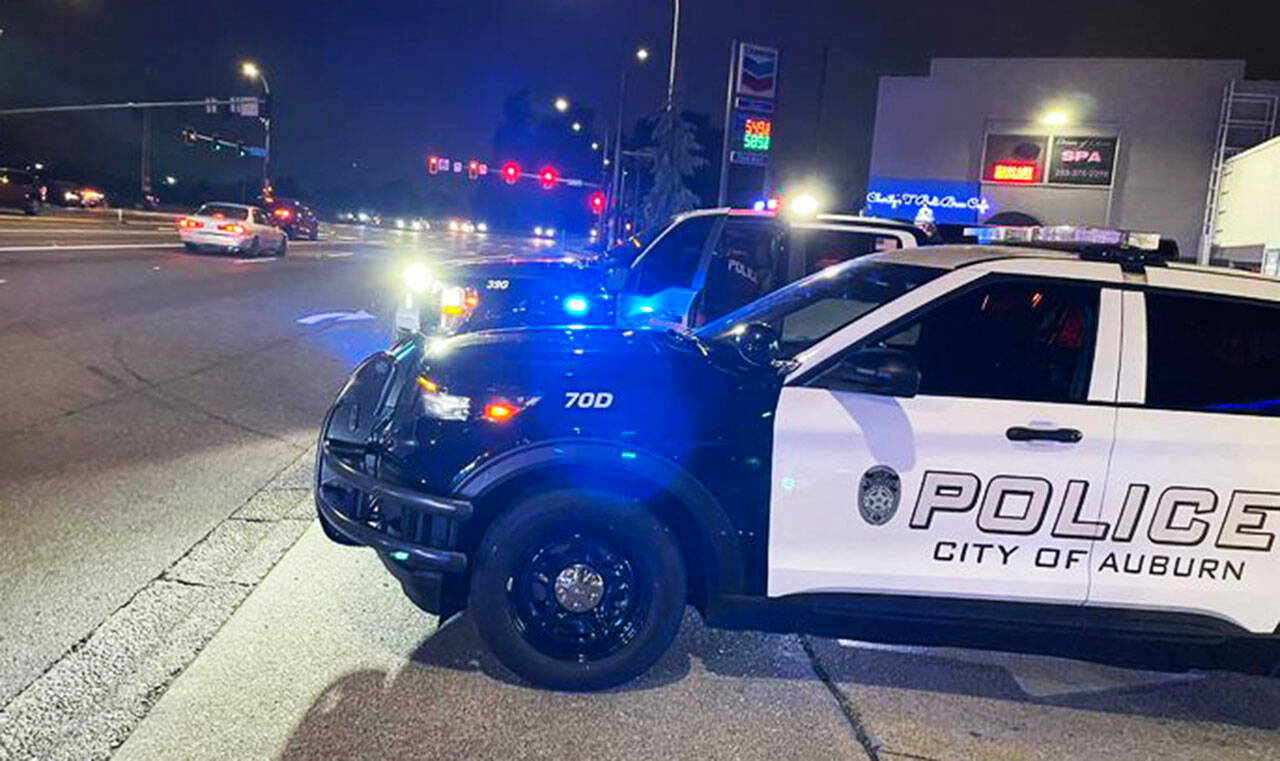
As it does every year, the City of Auburn expects to ask a few things of state legislators during their upcoming session in 2026.
These asks include providing funding for cities to fill police vacancies in Auburn and statewide, removing barriers that hinder the increase of affordable housing, and allowing relief for any unfunded mandates the state places on cities.
Auburn will also ask the state to work with cities to make technical fixes to vaguely-worded, conflicting or confusing state bills, and to forward to the city specific language on interviewing juveniles about their involvement in criminal activities.
Auburn City Councilmembers discussed the city’s legislative priorities during a study session on Dec. 8 at Auburn City Hall. Below is a selection of its asks. The Legislature’s 60-day session begins Jan. 12, 2026.
More police
At the top of its wish list, Auburn will press the state to help fund more police officers, as city officials say, to enhance officer safety, speed up response times, and improve the Auburn Police Department’s ability to respond effectively to local public safety needs.
As said above, Auburn isn’t the only city dealing with this problem. According to FBI data analyzed by the Washington Association of Sheriffs and Police Chiefs (WASPC) released on July 28, Washington in 2024 ranked dead last in the nation in law enforcement staffing for the 15th straight year.
As WASPC recently told the online publication Axios, based on the state Department of Commerce’s $154,704-per-officer estimate, the cost of bringing the state up to the national average for police staffing would be more than $1 billion annually.
Auburn Police Chief Mark Caillier has said that a combination of factors, including recruitment challenges, high turnover rates, public criticism and budget constraints are responsible for this problem.
Auburn also expects to ask the state for more money for officer wellness within police agencies, and for permission to tap “additional funding sources” for officer recruitment and retention, such as impact fees, direct funding from the state, or a councilmanic public safety sales tax, which does not require voter approval.
Councilmember Kate Baldwin asked whether the city would need those “additional funding sources,” given its recently-stated intention to enact a sales tax to beef up public safety.
There are fears, Mayor Nancy Backus responded, that “in the upcoming session lawmakers will place more restrictions on the use of the funding.” And, she noted, because of vaguely-worded, conflicting, and confusing language in state bills, “all of the cities that submitted the sales tax for approval this year were declined, even though they met the letter of the law.”
“We’re seeking more clarity on those items,” Backus said.
Drug-free school zones and other issues
Because of ongoing public safety issues related to illegal drug use, the city plans to ask the state to restore drug-free school zones, to extend them into community parks, and seek continued funding for therapeutic courts, recovery programs in jails and after-treatment supports.
Another ask relates to impacts to towing companies stemming from the Seattle v. Long decision in 2021. Auburn officials say the city has been forced to spend more money on towing services. Auburn will ask the state to provide additional dedicated funding to cities for towing services, or an increase in funding to the state reimbursement account.
In the Seattle v. Long decision, the Washington State Supreme Court ruled that that city’s impounding of a truck that a homeless man was using as a home, and charging him for towing fees, was unconstitutionally excessive. In its decision, the court concluded that the truck qualified as a homestead, and the city’s actions had deprived Long of his means of making a living.
The city expects also to ask lawmakers to reject any bill or action that puts extensive restrictions on the use of Flock cameras or other automated license plate reading equipment. Further restrictions, the city says, would make it harder for police to find criminals, missing and vulnerable people, and to track stolen vehicles.
Regulatory and land use
Because of the large number of regulatory processes that hinder bringing affordable housing projects to completion, the city will ask the state to do something about “an outdated and overly burdensome process,” that adds time and money to a project.
So the city will lobby for legislation related to affordable housing, missing middle housing or other land use laws to provide a safe harbor for those cities that are creating, or in the process of creating, their Housing Action Plan (HAP), in line with previous legislative actions that included grant funding.
It will also ask the state to dedicate funds to the rehabilitation of single or multifamily units to ensure housing stock is readily available in the market, as it is environmentally sustainable and far less expensive to preserve existing housing stock instead of building new units, according to city officials.
There are few programs that help maintain older homes and multifamily complexes which results in one of two outcomes:
• Older properties are maintained appropriately, but the investment is reflected in increasing rental costs, or;
• Older properties are not maintained, which helps keep rental costs down but at the sake of declining health and safety for tenants.
Auburn will ask the state to allow cities to update local laws if or when it is in response to a state mandate rather than having to go through all of the obligations related to the planning commission or the State Environmental Policy Act (SEPA) public notice, for example.