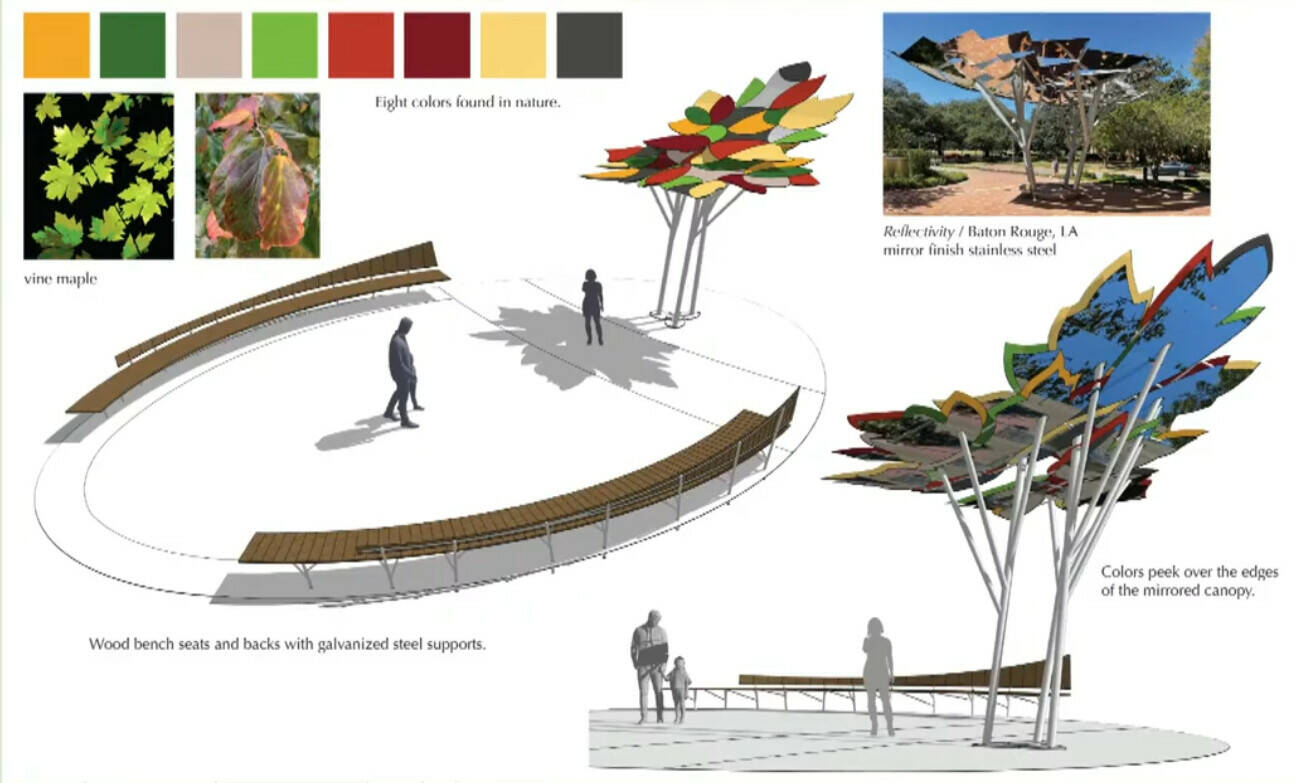
On Feb. 2, the Auburn City Council authorized Mayor Nancy Backus to approve the conceptual design of The Gathering Tree, a public art piece destined for the Auburn downtown park-to-be immediately east of the future Auburn Avenue Theater and part of that overall project.
The resolution also gives Washington artist John Fleming the go-ahead to create and later install the work.
The Auburn Avenue Theater Project budget is $12.1 million, including a developer contribution of $4 million, according to the city communications manager Jonathan Glover.
At more than 7 feet tall, with vibrant, natural colors of red, orange and brown metal leaves that reach out over the edge to the polished surfaces on its underside, The Gathering Tree is meant to be what the design team hopes it will be: a public gathering place.
To the Jan. 26 study session, Auburn Arts and Recreation Director Julie Krueger brought the team that’s put it together, including Fleming and Arts Program Supervisor Allison Hyde.
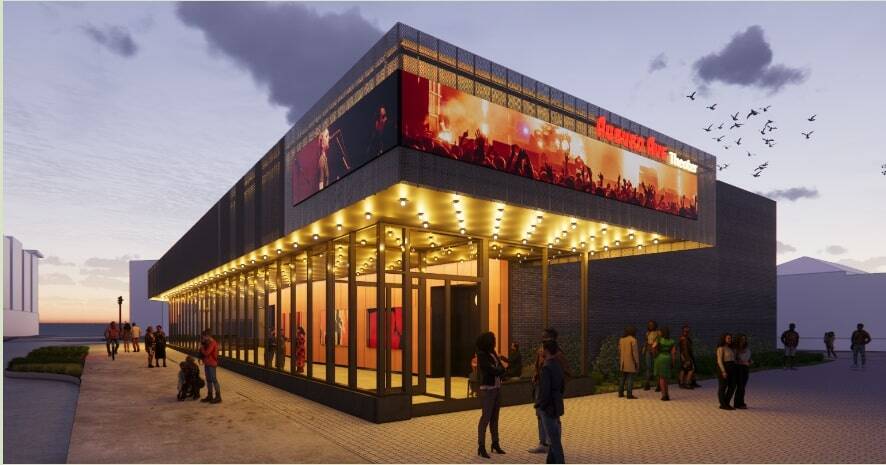
An artist’s rendering of the exterior of the future Auburn Avenue Theater. Photo courtesy City of Auburn.
Fleming described the artwork as a metal sculpture of a tree that will be flanked by two curved benches leading up it, making it a coaxing draw.
Fundamentally, the piece is also the design team’s answer to the questions members had to answer when they first met last August: what is Auburn, and what is the Muckleshoot Tribe about, and how will its design elements incorporate both the city and tribe?
“What could be a better beacon than this tree (representing) the connection of nature and the city?” Fleming asked city officials on Jan. 26. “We (the design team) moved in the direction of natural forms, first one leaf, and then actually thinking about what leaves would represent Auburn, and what leaves would represent the tribe. And we were thinking of vine maple leaves, which were starting to develop more as a bolt-able collection of those leaves.”
“I like this idea of past, present and future,” Fleming added, “and how maybe we could touch on this whole spectrum, from the future being this polished, maybe high-tech image and get back to a very organic thing.”
The $2.1 million park, a key addition to the future theater, will provide something Auburn residents have never had: a centralized open green space in the heart of downtown, connecting the theater to the Postmark Center for the Arts, East Main Street, and the recently completed B Street Plaza.
In other words, it will be part of an overall community hub of arts and culture, a magnet to draw people into the downtown to catch live performances and spend money.
It will be included in the bid package with the theater, which the city earlier estimated will cost between $6 million and $12 million.
Last July, a selection committee chose Fleming out of 46 artists to create artwork for the site. On Dec. 18, 2025, he presented the final conceptual design to the Auburn Arts Commission, which approved and forwarded it to the city council.
“He (Fleming) has a really incredible breadth of past work, with public artworks all across the region and the country,” Hyde said.
Hyde said the city identified the plaza parcel and downtown park in 2024 as an “ideal and important location for public art, accommodating 1% for art, and highlighting the site as a community hub of arts and culture in downtown Auburn.”
The plaza at the east entrance of the theater will also serve as a space for general passive uses, community events, park programs and more.
The city will use the western section of the park, which includes the remaining portion of the theater parcel, as a gathering plaza for the east entrance of the theater, with added hard surfacing and stormwater facilities.
For the park, the city tapped the initial $967,000 from a King County Conservation Futures grant, with $717,000 of it already spent to acquire the property and for demolition of the comic book store at the east end to open up room. The city has already been reimbursed for this money.
Among its remaining funding sources are a $250,000 direct appropriation from the state and park impact fees, and beyond those, it has cobbled together some funds remaining from other downtown projects.
In other action, the council adopted:
• A resolution approving a Mutual Aid Interlocal Agreement between the City of Renton and Auburn related to the 2026 FIFA World Cup. (See accompanying story.)
• A resolution formalizing Auburn’s participation in the King County-Cities Climate Collaboration Interlocal Agreement, making the City of Auburn a partner city in the effort.
• A resolution authorizing the mayor to execute agreements to accept Stormwater Capacity Grants from the Washington State Department of Ecology for implementing the National Pollutant Discharge Elimination System (NPDES) Municipal Stormwater Phase II permit requirements.
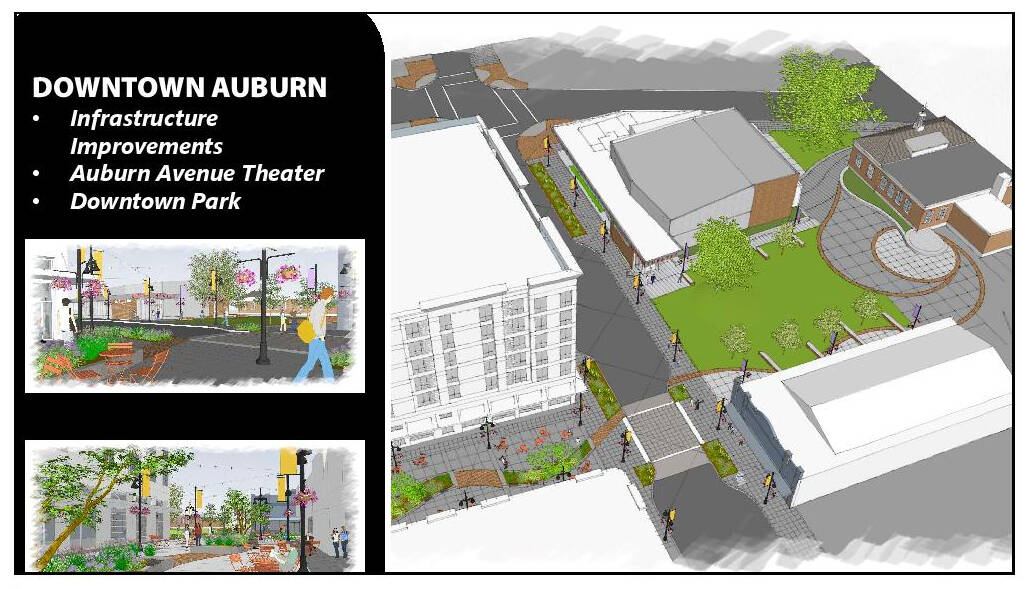
Rendering of the property surrounding the future Auburn Avenue Theater. Courtesy of City of Auburn