
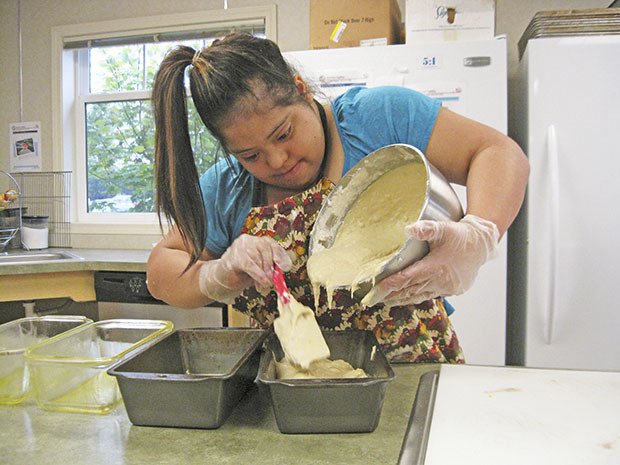
Spatula firmly in hand, head of brown hair bobbing over a mixing bowl, 19-year-old Maria is all concentration, smiles — and that special form eagerness takes whenever a young body is whipping up a goodie.
Special education para-educator Jaime Billingsley asks Marie to step aside so Skyler, 19, can “have his turn” at speeding this mouth-watering batch of banana bread on to its fated hour with the oven.
As Maria and Skyler work in the kitchen, and a meeting for parents rolls on in an adjoining room, a young man, Jacob, flips through vocabulary cards, determined to ingest every word. If he wants work in a restaurant, he has to know them all.
A typical weekday morning in a happening place called the TAP building, southwest of the Auburn swimming pool.
The 4-year-old Transition Assistance Program is all about giving 18-21 year-olds with significant disabilities their last job-and-life skills before they are aged out of the public school system, said Kyle Grafstrom, a special education teacher in his first year with the program at Auburn High School.
Maria, who has Down Syndrome, and Skyler, who has Fragile X Syndrome, which is similar to autism, are in their first year of the program. From 8 a.m. to 1 p.m. every day, the duo is in the kitchen, cracking eggs, making spaghetti and meatballs, concocting other treats.
“Maria is doing great,” said Billingsley. “She’s got a natural ability in the kitchen. She can mash bananas all by herself. She is pretty independent.”
Of the 30 students in the program, one, wheelchair bound, has to be fed through a tube throughout the day. The rest don’t have significant health programs but may struggle with significant cognitive delays or other issues.
The idea is that by taking advantage of the support they get in the program, all of the students can land full-time paid jobs when they leave.
So they can live on their own. Have a car. Pay their own bills.
“That’s big stuff, but they deserve the right to be employed just as much as anybody else. And if they show the drive and work ethic, they’ll get jobs and be productive members of society,” Grafstrom said. “Each year there are more and more job sites for these youngsters to go to. Last year we had an 80-percent employment rate with our graduating students. That’s pretty good.”
As he spoke, 15 students were already out at their work sites in the community.
Hanna Grace, 19, in her last year with the program, was back at the building by 10 a.m.
“At Trotter’s when I was just beginning I started clearing and busing tables. And while I learned, I got more confident,” Grace said.
Next year, Grace said, she’ll probably be with the Division of Vocational Rehabilitation, “where people with disabilities can find a real job.”
Grafstrom wants the community to know more about the program.
“We are trying to build more connections in the community, more awareness of what we do, the services we offer, and let people know we are here,” Grafstrom said.
“We just started a fundraiser this year with the Magical Night of Giving at The Outlet Collection Mall. In one week we’ve raised $700. That money we use for special outings and events, like Mariners games, ‘The Lion King’ play, and extra special things for our students.”