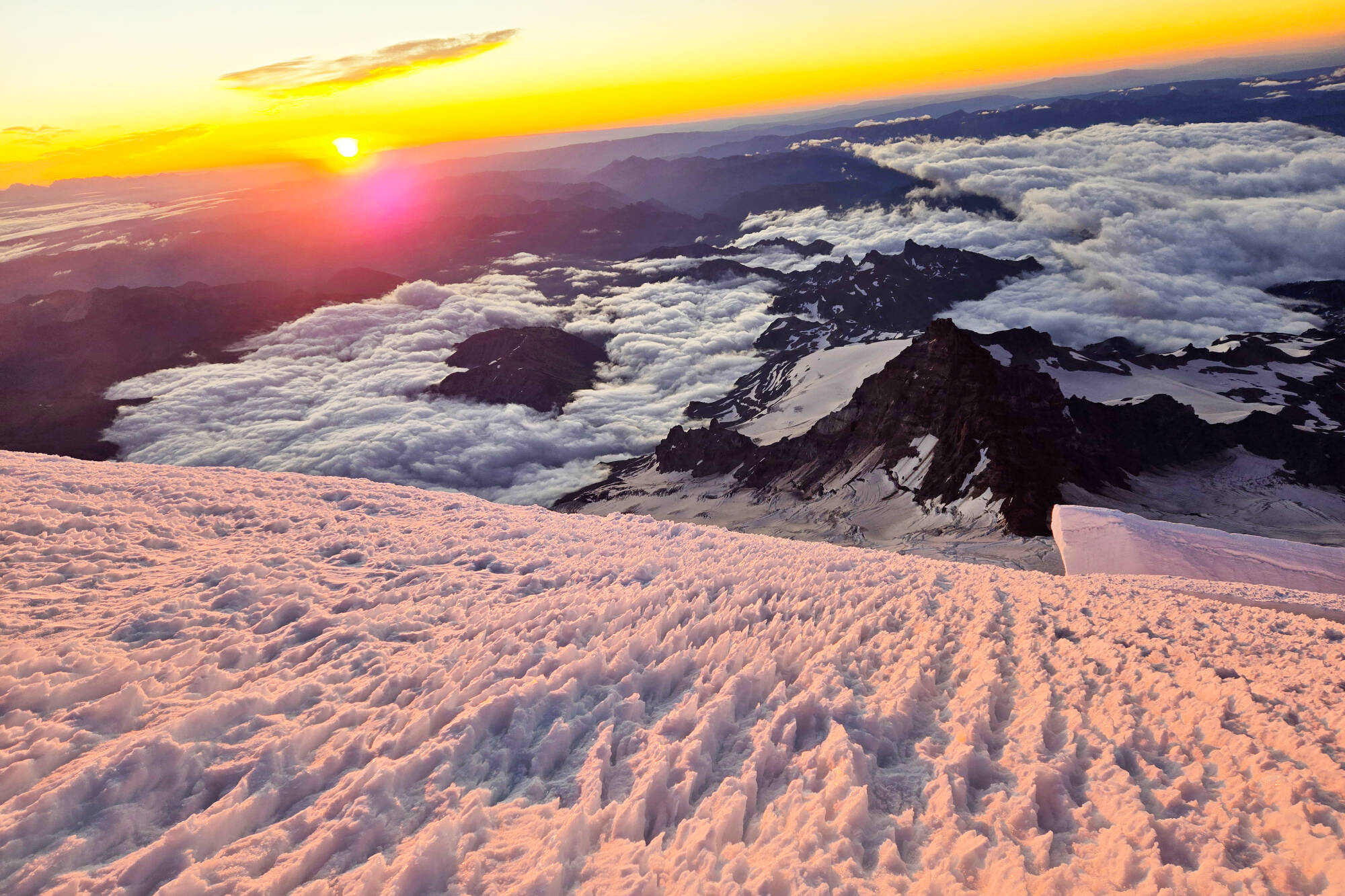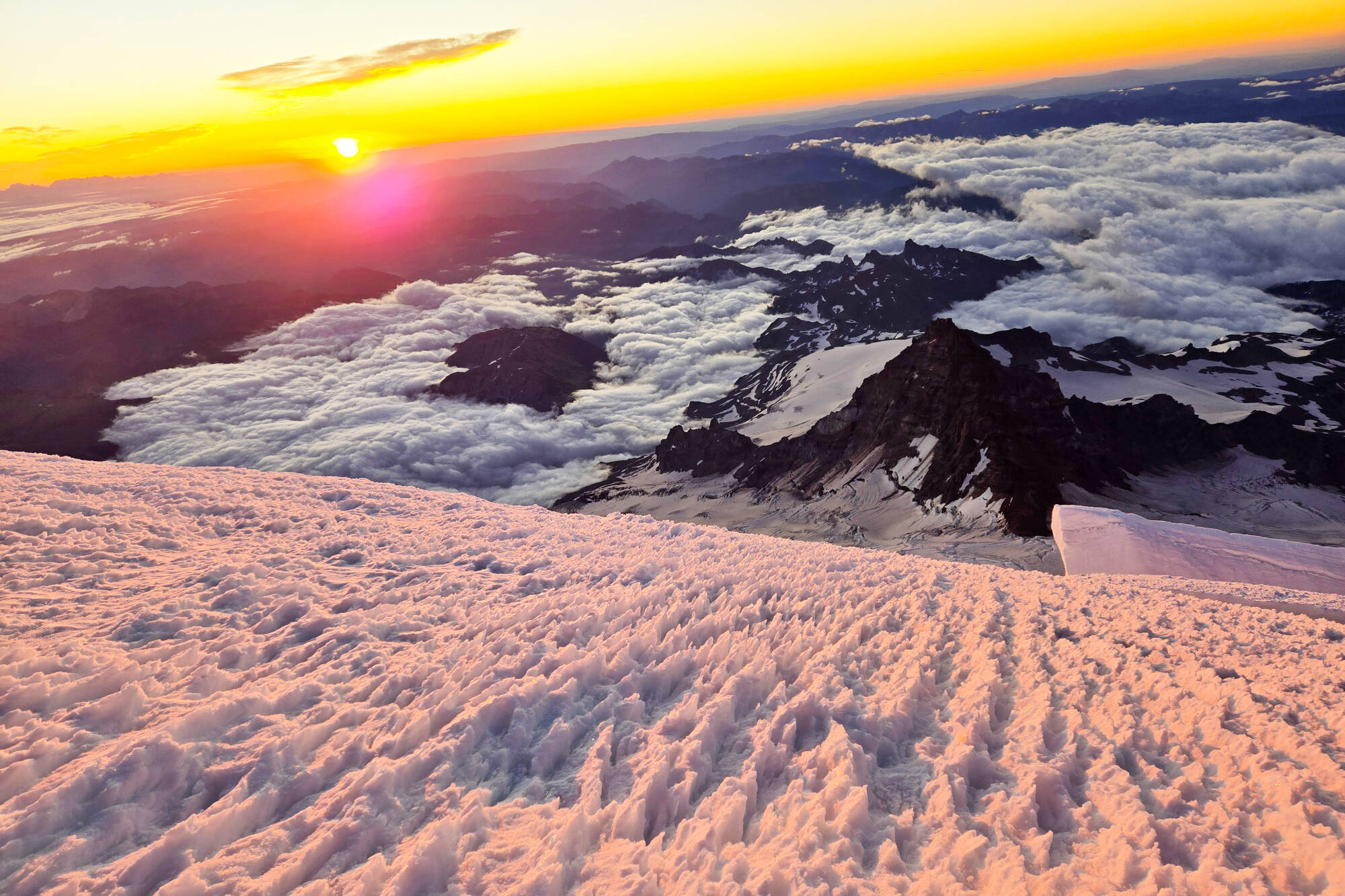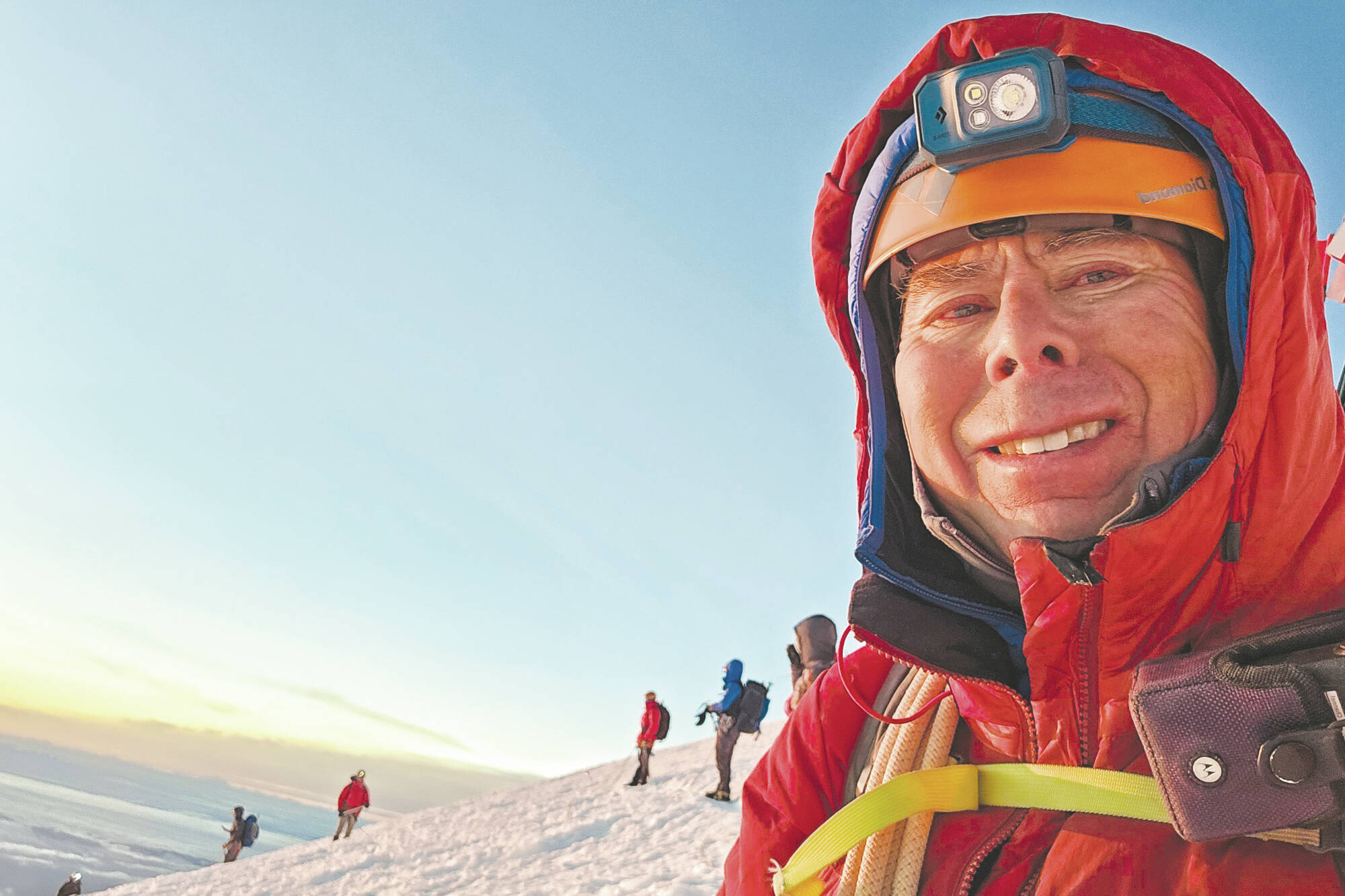
Brent Okita has summited Mount Rainier more than 600 times.
That’s 12,600 hours on the famous landmark. And given that summiting season is only four months long, that means the 64-year-old has spent an average of 323 hours on the famous Washington landmark every May through August for the last four decades.
For comparison, the average American spent about 300 hours watching television in the same time frame last year.
Okita has an excuse, of course — he’s a guide that brings groups up the mountain via the Disappointment Cleaver-Ingraham Glacier route.
Historical experts say there’s no recorded reason why it’s called Disappointment, but according to Okita, “the first ascensionists climbed it in unsettled weather, so they couldn’t really see too much. So when they got to the cleaver (a ridge that separates two glaciers), they thought they were on the summit. And then the clouds parted and they saw they still had 2,000 feet to go.”
Okita likely knows a lot of obscure Rainier history, given he’s devoted his life to climbing it.
His love of mountains started when he spent five years in Switzerland as a kid, where he learned to ski.
After his family moved to New Jersey in the 1970s and Okita went to college in Vermont, he took a year off to live in Jackson Hole, Wyoming, when climbing peaked his interest.
And “[w]hen I graduated, I knew I needed the big mountains to be happy,” he said.
They traveled around the country for a bit, looking for somewhere to be near a mountain and find employment, until Okita secured a bartender gig at the Crystal Mountain Resort.
After a few years, one of his coworkers became a guide and encouraged Okita to do the same.
“I started dating my wife… that same year, and she actually had more experience climbing than I did,” he said. “So between my buddy and her help [I got] my skills up for the guide tryouts.”
His first ever ascension was in 1986, without having summited the mountain beforehand.
Mount Rainier isn’t Okita’s only accomplishment — he’s summited Mt. McKinley (formerly Denali) 25 times, guided in the Alps of Switzerland and Dolomites in Italy for 14 years, led trips to Mt. Vinson in Antarctica and Kilimanjaro in Tanzania, and has been on Everest twice — summiting in 1991 and returning in 2001 as part of the Mallory and Irvine research expedition to learn if those pioneer climbers may have first summited it in 1924.
“I feel incredibly fortunate to be able to spend my life and career in the mountains where I’m most happy. I am proud that I’ve been able to lead thousands of climbers safely and successfully in an environment not without risk,” Okita said about his achievements. “Through mountain climbing and guiding I’ve lived a very full and rich life. It’s not the numbers that count but the people I’ve met and the experiences we’ve shared that mean the most.”
CAMP MUIR TO COLUMBIA CREST
The Disappointment Cleaver-Ingraham Glacier Direct route (DC for short) is the most popular on the mountain — 75% of all climbers take this route — and is one of the most guided routes in all of North America, according to the National Park Service.
You may think summiting the mountain is a lonely trek, with just you (and your group and/or guide) braving the elements alone as you climb 9,000 feet over nine miles from the ranger station to the top.
But that’s not the case — more than 9,500 climbers conquered the climb in 2022 — and that’s down from the 11,500 climbers back in 2017. The summit is a bit less crowded, as only 50% of climbers actually make it to the crater rim.
Okita said the first part of the trek to Camp Muir is an endurance test, but requires no technical expertise to hike up nearly 4,800 feet over about 4.5 miles.
But that doesn’t mean it’s not difficult.
“It’s not easy for folks, if they haven’t prepared really well, especially with the pack, the right kind of training,” Okita said, adding that this takes about five hours.
For hikers, that’s the turn-around point to head home.
For climbers, this is just the start.
The guide company Okita works for has a bunk for the climbers to end their day in before they continue up the volcano.
But they better get to sleep early (probably easier than usual, after that hike) because they’re up again at midnight to start the ascension — or earlier, depending on the heat and crowds.
“It’s actually a lot more dangerous to start your climb later, when it lightens up,” Okita said. “We’re trying to get up and down the mountain… before the glaciers have a chance to soften up with the heat of the day, and the snow tends to get sloppy.”
The snow bridges also get weaker as the day goes on, “so there’s an increased chance of crevasse falls that way,” along with possible rock falls, he continued.
This is where the climb gets technical, and climbers need to be proficient in belayed climbing and glacier travel via rope, not to mention be familiar with crevasse self-extraction and rescue, should the climb go south.
Okita is doing this portion of the climb with a 35 or 45-pound pack, while his clients are shouldering around 20 pounds each — about 15 to 20 pounds lighter than when they were coming up to Camp Muir.
Climbers first reach the Cowlitz Glacier, then the top of Cathedral Gap, and after arriving at Ingraham Glacier will probably take a rest on at the Ingraham Flats Camp. There is no toilet, though.
After catching a breather, ascenders make their way to the top of Disappointment Cleaver.
But now they have to cross what’s been dubbed “the Icebox,” which is a high-hazard area known for collapses, and the “Bowling Alley,” infamous for spontaneous rock falls.
The National Park Service recommends climbers should be exposed to these areas for less than ten minutes, and to never, ever stop in these zones.
Safely past these areas and on top of Disappointment Cleaver, it’s time to reassess continuing the summit and consider all factors — weather, light, supplies, and energy levels — before marching on; the NPS says climbers can expect it will take them at least as much time from here to the summit as it took them to get from Camp Muir to this point.
The NPS calls this part of the ascent “an uninterrupted maze of large crevasses and steep slopes… there are no permanent features or landmarks along this stretch as the route is 100% glaciated.”
But if the stars have aligned and the climbers reach the Columbia Crest snow dome and Register Rock (where the summit register is located), they’ve earned your hour break at back in the majesty of Mount Rainier and their achievements.
Okita has had many amazing climbs with fantastic groups of people, but some of the best are the first-timers.
“For many, many people, this is the most physically challenging and mentally challenging thing they’ve ever done,” he continued. “… That’s rewarding.”
Even in his later years, Okita continually trains in order to be able to make the ascent multiple times a season.
It’s all about the quads, he said — quads and breathing, so he recommends hiking and biking often, and with a heavy pack. He doesn’t recommend training inside, because the body needs to be more used to varying temperatures.
He said there are tons of places around Enumclaw great for training, and beginners can look to the Mount Peak trails to start.
But it’s also important to have a rest day, he continued; even Okita decides to sleep in after a climb.
How long?
“Oh, I don’t know,” he replied. “Maybe eight or nine.”