
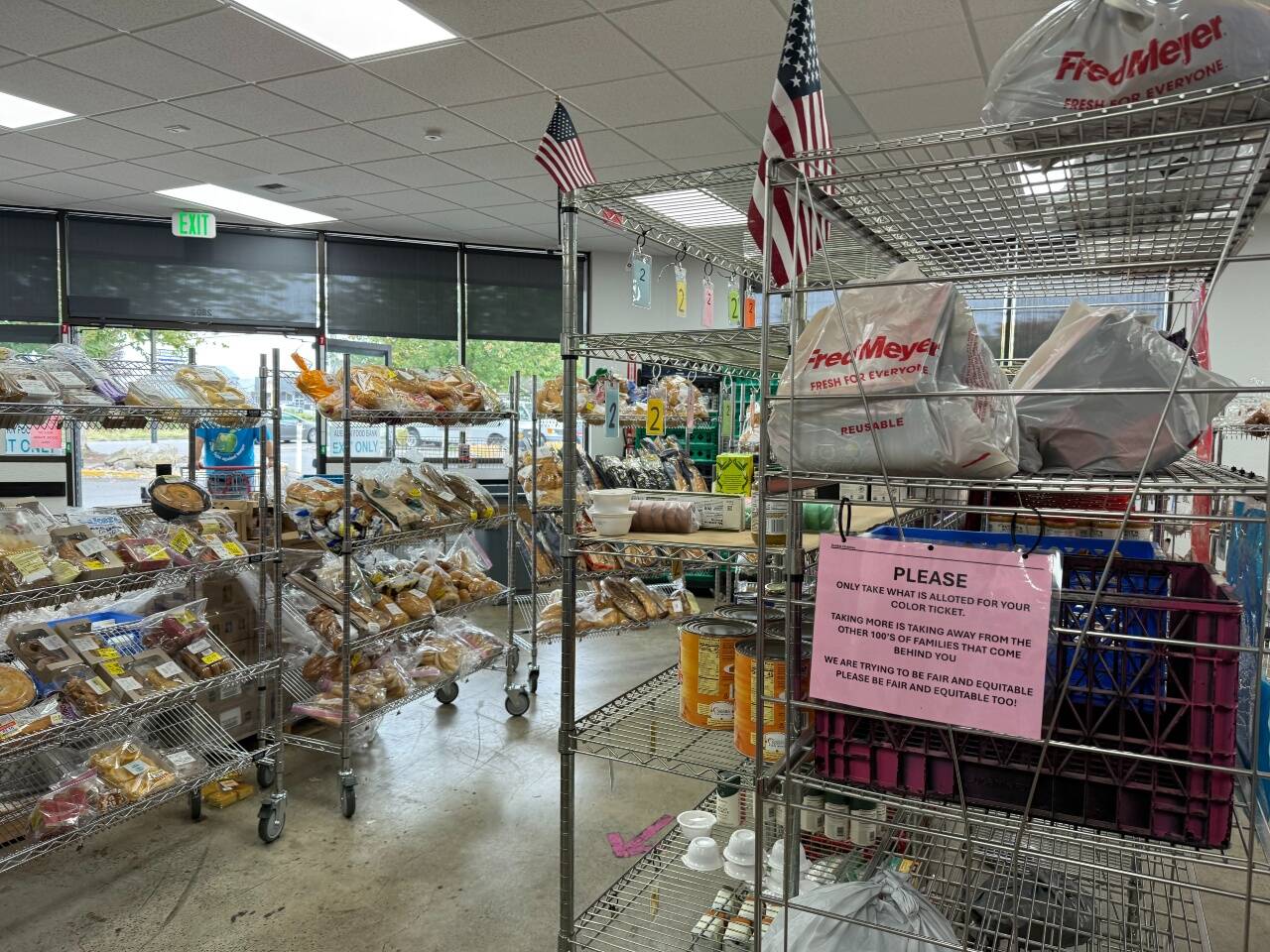
The U.S. economy was already in the doldrums. Expenses were up, donations down, and the Auburn Food Bank’s hard-working staff and volunteers were struggling to keep the shelves stocked and the doors open.
Then more than a month ago, and counting, a budget stand0ff between Republicans and Democrats shut down the federal government.
In a blow to food banks, the Trump Administration announced its plans to discontinue SNAP, the federal Supplemental Nutrition Assistance Program. The program provides food benefits to low-income families to supplement their grocery budget.
Debbie Christian, executive director at the Auburn Food Bank, explained what happened when the SNAP news broke.
“Panic,” she said. “People were very afraid, very nervous, trying to figure out how they would survive. It brought people here last week in droves, and we’re still seeing it.”
In a typical week, Christian said the food bank serves 180 or so clientele. Last Thursday (Oct. 30), 249 people lined up, and on Nov. 3, there were 229 people.
According to government records, SNAP helps feed about 40 million Amerians every month, one tenth of the population, and 80% of the households it feeds have children.
As the food bank started seeing the bottom “just completely drop out” last Thursday, Christian said, a miracle occurred. On that day a local TV channel called, asking to talk to Auburn School District Superintendent Alan Spicciati, who was at the food bank at the time conversing with Christian about how the SNAP news was affecting families. One of the news channel’s reporters then asked if she could drop by the food bank to join in the conversation.
“The channel put out the video immediately,” Christian said. “I put a new Amazon wish list out, and we started seeing people coming through the door with gift tags on boxes and with checks in hand. We shook hands and thanked them. That and the Amazon wish list have helped me make purchases very quickly.”
For the moment, those two factors are what’s keeping the food bank keep going.
“But we are in no way out of the woods,” Christian said.
Even apart from the demand the pending holidays put on the Auburn Food Bank, Christian said, the bad news from Washington, D.C., hit at the worst possible time.
“We have nothing in the warehouse at this moment through all of this. With high prices, it’s been hard for a while to get food in the door. We haven’t had stuff coming in every day, but we still keep going. Last Thursday, we were so low at the end of the day we had nothing left to put on the shelves. If not for people hearing about the situation and what we’ve gotten from the Amazon wish list, we wouldn’t have been able open on Friday.”
“Also, no one has any idea on how long the shutdown will last. People tell me they’re worrying about whether to use the SNAP money to buy food to feed their families or pay rent and utilities.”
It’s worth noting that during every previous shutdown, SNAP was protected, but not this time. The federal government has announced that as of Nov. 1, there would be no more benefits, even though the U.S. Department of Agriculture has billions of dollars in contingency funds that could keep the program going for at least another month.
Christian, who is a Christian herself, sent up a prayer: “Hey, God, you know the five loaves and two fish you multiplied to feed the masses? Right now, we need multitudes of fish.”
FYI
• On Nov. 3, the Trump administration announced it will partially fund SNAP for November, following two rulings on Oct. 31 that required the government to continue funding the food program. About 1 in 8 Washingtonians use SNAP.
• According to the Associated Press, “it’s not clear exactly how much beneficiaries will receive, nor how quickly they will see value show up on the debit cards they use to buy groceries,” and “November payments have already been delayed for millions of people.”
• Gov. Bob Ferguson announced on Oct. 28 that nearly $2.2 million per week will be directed to provide additional support to Washington’s food banks.