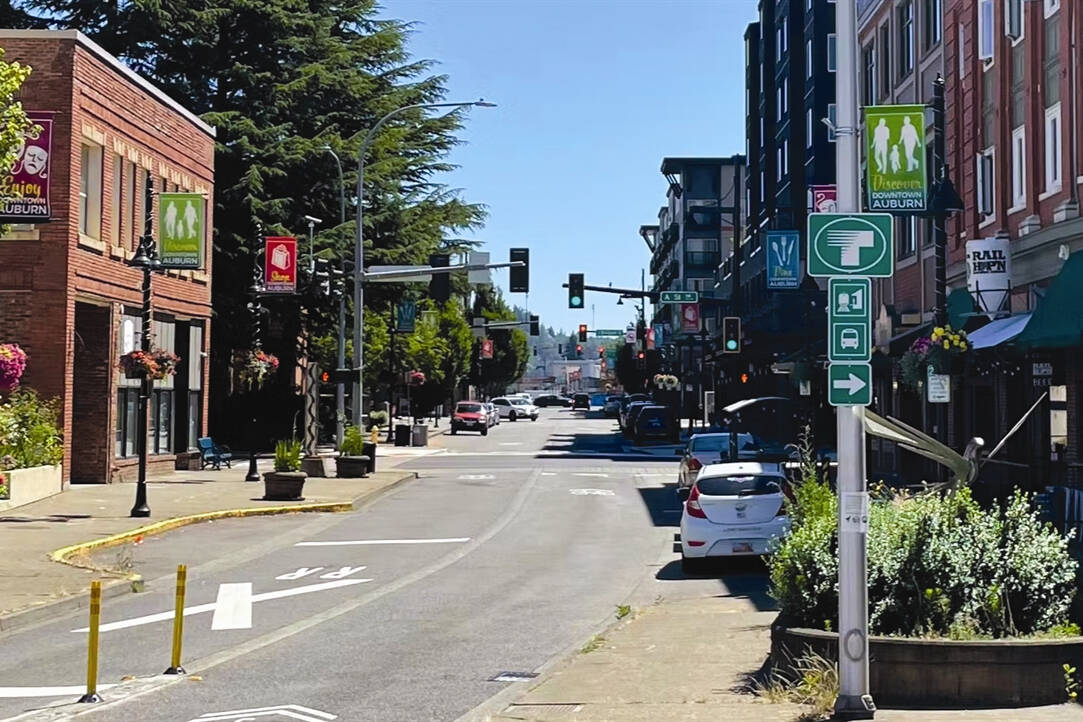
If you have ever enjoyed the South Division Street Promenade in downtown Auburn, you have benefited from a state program that provides financial help to fund local public improvements in areas cities have identified for revitalization.
Since 2010, via what’s called the state’s Local Revitalization Financing (LRF) program, Auburn has asked for a small percentage of the sales tax that the state collects there, and received a portion back to pay for some of its debt financing on the project.
On Feb. 9, city finance director Jamie Thomas met with the Auburn City Council to discuss setting the portion of the state sales tax the city will ask for this legislative session by ordinance at 0.014%. The city estimates that amount will bring in $250,000 during the state’s fiscal year between July 21, 2026, and June 30, 2027, though it has never received the full amount.
Thomas noted that in 2009, after the state passed the bill that allowed LRF areas in Washington cities, Auburn designated what it wanted to revitalize and issue debt on.
“As long as we could prove that the amount of new sales tax that these revitalized areas would produce (would be) at least $250,000 or more (to put to) the state’s portion of the sales tax that they would be collecting,” Thomas said, “they said that for 25 years, we could collect $250,000 a year back from them to help pay for the bonds, and then whatever financing it took to do that revitalization.”
In 2010 after getting the state’s approval, the city issued $7.24 million in bonds to perform the work on the Promenade, including road reconstruction and sidewalks along Division Street and along Auburn Avenue.
Since 2010, the City of Auburn has been investing $10 million of federal and state funds in the South Division Street Promenade Project and other downtown projects to make it easier and more attractive for private sector investment. According to the city’s website, it has:
• Relocated public and private utilities out of alleyways to remove infrastructure barriers for redevelopment of adjacent properties.
• Upgraded water, sewer, storm and private utilities, and excess underground stormwater capacity exists for private new development to use.
• Installed new street paving.
• Constructed 10- to 20-foot-wide sidewalks with landscaping.
• Installed new LED street lights throughout downtown and a new traffic signal at Main Street and Division Street.
• Placed new street furniture, and trash receptacles.
• Installed a new ornamental gateway arch.
• Constructed new and improved downtown public plazas.
• Made additional downtown improvements including an outdoor rotating sculpture garden and pedestrian way-finding kiosks.
As of Sept 31, 2025, the city still has $2.94 million outstanding on the bonds, although in 2020, it did refinance the debt at a much lower interest rate. The city’s annual debt service is about $270,000, so the lion’s share of this sales tax ($250,000) pays for the debt service. The city does supplement a little bit with its REET funding (real estate excise tax), which it combines with grants and interest earnings as all are an allowable use of the refunding.
“Just to reiterate,” Thomas told the council, “this is not an additional Auburn sales tax; it is a portion of the state sales tax they have already levied, and we’re just clawing back a portion of what they collect.”