Man sentenced to six years for drug and gun crimes
Published 11:30 am Friday, February 13, 2026
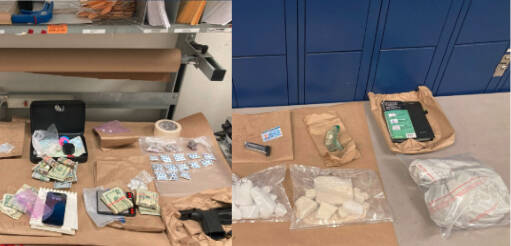
A man whom Auburn police investigated, searched and then arrested at a Des Moines hotel was sentenced to six years in prison on drug and gun charges related to the man possessing cocaine, over two kilograms of fentanyl and a ghost gun.
On Feb. 9, a U.S. District Court sentenced Dennis Aguilar Huisa, 37, a Honduran national who lived in a Des Moines hotel, to a total of six years in federal prison. Huisa was sentenced for the charges of possession of controlled substances with intent to distribute, possession of a firearm in furtherance of drug trafficking crime, and one count of money laundering. Huisa pleaded guilty to those charges on Nov. 12, 2025.
According to the Department of Justice (DOJ), between August 2023 and November 2024, law enforcement made contact with and arrested Huisa three times, and each time, officers uncovered drugs, and an investigation found that he had deposited over $300,000 in drug proceeds to his bank account. In one of the contacts, Huisa’s infant was exposed to drugs, given Narcan after a suspected drug overdose and then drugs were found in the infant’s system.
The last contact and arrest was on Nov. 1, when the Auburn Police Department’s Special Investigations Unit executed a search warrant at the hotel where he was living.
According to the DOJ, Huisa will likely be deported to Honduras following his prison sentence.
Details of the case
According to the DOJ, Puyallup police first contacted Huisa on the side of the road on the morning of Aug. 15, 2023, when he told officers that his car had overheated and that he was waiting for it to cool. Officers then observed that the license plate on the car did not match the vehicle type listed on the registration, and they placed Huisa in custody while determining whether the car was stolen.
An officer then noticed blue pills in Huisa’s car, and the car was impounded. In the car, 1,000 fentanyl pills, powder suspected of being fentanyl powder and a scale with drug residue were found.
On Sept. 7, 2024, Puyallup officers responded to a report of a nine-month-old infant who stopped breathing. Huisa and a woman met officers outside a box truck, holding the infant in their arms.
Officers worked to get the infant to breathe before fire personnel continued the efforts. The infant was taken to Mary Bridge Children’s Hospital in Tacoma, and was given Narcan.
The infant’s blood tested positive for fentanyl, amphetamine and oxycodone. The infant survived.
The law enforcement investigation found that Huisa, suspecting that the infant had been exposed to fentanyl or other drugs, gave the infant two doses of Narcan. Officers then searched Huisa’s box truck and found approximately 115 fentanyl pills, fentanyl powder and $16,000 in cash.
Auburn officers then arrested Huisa on Nov. 1, 2024, when the Auburn Police Department’s Special Investigations Unit served a search warrant at a Des Moines hotel where Huisa had been living. In the hotel room, officers found small packages of fentanyl powder packaged for sale. According to the DOJ, Huisa was attempting to flush the packages down the toilet when he heard law enforcement arrive.
Officers found additional fentanyl powder, methamphetamine and cocaine in other places around the hotel room. Officers then again searched Huisa’s box truck, where they found two kilograms of fentanyl powder and a Polymer 80 “ghost gun,” a gun made without a serial number.
According to the DOJ, the financial investigation revealed that between July 2022, and September 2024, Huisa made $370,000 in cash deposits to his bank account. These were proceeds of drug dealing, the DOJ stated.
According to the DOJ, at the sentencing, Huisa told the court he was “very ashamed and cannot forgive myself for what I have done to my daughter… I did not come here to deal drugs.”
The prosecution asked for an eight-and-a-half-year sentence, citing that officers contacted Huisa on three different occasions and he continued to engage in drug trafficking activities “to the detriment of his infant daughter,” the prosecution said.
“Huisa appeared to be undeterred following the overdose of his child and continued to engage in the distribution of controlled substances,” the prosecution stated.
According to the DOJ, at the sentencing hearing, U.S. District Judge John C. Chun said fentanyl is dangerous and has destroyed so many lives, and Huisa must have known that he was putting himself and his family at risk.